Sunday, February 22, 2009

A Strong Woman... Literally
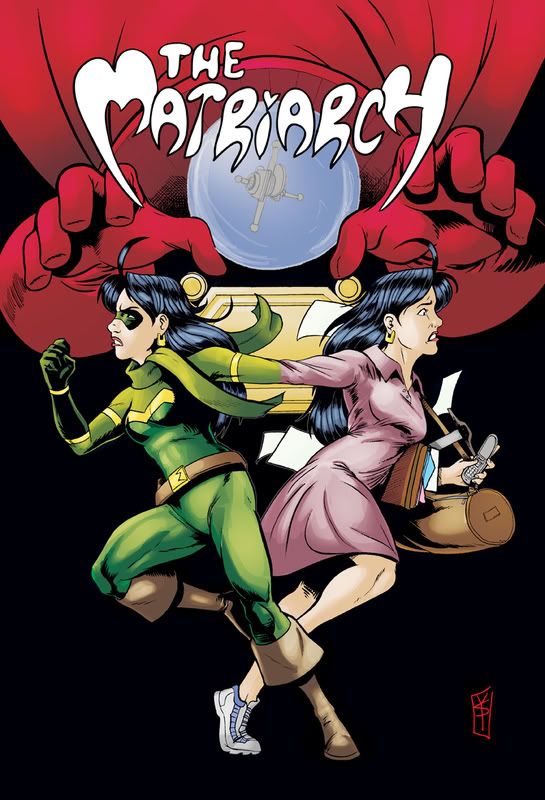

Superhero comics are often described as being white adolescent male power fantasies, which is, in my opinion, exactly what they are. That’s one bit of conventional wisdom that seems clear. Exactly what it means in terms of having, say, a woman in the lead role, however, is less clear. Does one need to subvert the traditional male power fantasy and create, instead, a female power fantasy? Do women even have power fantasies?

It seems to me that most women do have power fantasies (and the ones that don’t probably aren’t reading superhero comics). If we take as a given that superhero stories are, at least in part, power fantasies, is there a basic power fantasy common to both the male and female (as well as people of other colours, cultures, and sexual orientations) variations?
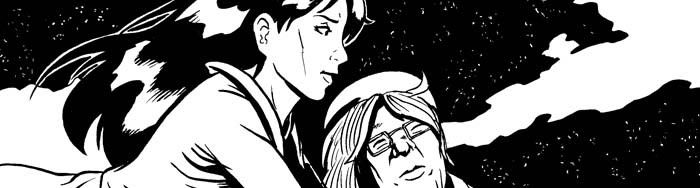

It seems to me -- again -- that there is, and that the commonality is the very thing intrinsic to all superheroic fiction: the presence of characters with extraordinary powers, talents, or psychological traits. Where the story goes from there -- who has the power, what they use it for, and how the super individual relates to the world around them -- is where most of the differences come in.

We all, though, I think, can agree that being invulnerable could have its uses. Being able to turn invisible, too (though whether this one breaks down as females fantasizing about turning invisible so as not to be seen, and males fantasizing about turning invisible so they can look at women -- though not the invisible ones, of course -- or if those generalizations don’t really apply, is an open question). Most of us, I think, have wondered what it might be like to fly.
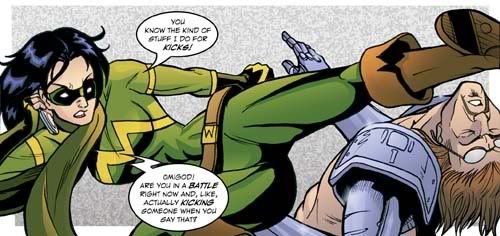


In The Matriarch, the webcomic I do with Steven Yarbrough about a superhero who is also a single mom, the power fantasy plays out largely as having the power to help the ones you love. Again, this is something I think most of us can relate to (although it doesn’t strike me as a particularly adolescent trait). Sherry, our protagonist, enjoys having and using her powers. There are times when she gets into trouble, of course -- times when things go poorly despite her making all the right choices -- but, generally speaking, having power beats having had no power.

We’ve been running for about a month now -- updating every Monday, Wednesday, and Friday -- and the majority of folks I’ve gotten feedback from (facebook, blogger, MySpace) are female (though that may be sample bias owing to the relatively small sample size).

As a writer, the most interesting thing about superhero stories (which, again, I see as largely white male power fantasies) is seeing what happens with someone else in the driver’s seat, whether it’s a woman, old people, or even an alien pet. But ultimately, in terms of expanded horizons (both for comics as a medium and for human beings), do we want to expand white male power fantasies to include everybody, or do we need to erect new fantasies reflecting the needs, wants, and desires of other people with other experiences? Are we ultimately more alike than we are different, or are we more different than we are alike?

women comics feminism feminist matriarch webcomic

Labels: , , , ,

Friday, January 11, 2008

A Woman Called Lauren

(Vote for Urbis Faerie at Zuda!)

Towards the end of 2004 I started writing a short story I'd had no prior intention of writing. I was a strict 1000-words-a-day guy in those days, and wrote exclusively in a safe, slightly distant third person past tense voice -- always after at least a couple of days of careful planning. And then one day, when I'd already completed my daily 1000 word quota, I suddenly typed these words:
The ad sounded perfect:

Walk to the train station. Outdoor swimming-pool on site.
Furnished/issues.


Lauren called on her lunch break and signed the
lease by fax when she was able to talk the landlord down to $300 a month.
The furnishing, she discovered later, was tasteful, and even a bit on the
expensive side: pine floors, mahogany table, and a red/blue/orange
loveseat that actually looked cool despite being plaid. The issues were a
tiny but perfectly proportioned couple who lived in the wall behind the bedroom,
but at $300 a month, and with the word issues included in the ad, Lauren had
expected something to be a little off about the whole thing...

Nothing all that Earth-shattering, but it seemed very strange to me at the time. The story ended up about 2,500 words, and I considered it something I'd written only for myself, and didn't expect I'd be able to interest a publisher in it. To my further surprise it found a home in the first market I sent it to: On Spec, the Canadian Magazine of the Fantastic. (In issue #62; order it here. I'll post the story to this blog if there's any interest.)

This signaled a shift in my prose writing that is till in effect more than three years later. It also introduced me to a character named Lauren whom I -- at least consciously -- did not create. She's some sort of dark horse of my subconscious mind.

The Coming Years of Good is the story of a young woman finding herself, and becoming comfortable in her own skin. Later I would take that same character and drop her whole (but without the continuity of the short story) into a comic called Urbis Faerie, which is in this month's competition at Zuda.com (vote for it! You MUST!!).

From the outside looking in, these must seem the most mundane of personal revelations, but I've always been a bit dense when it comes to seeing myself in my own work. I only realized a few days ago that The Coming Years of Good was really the story of me finally getting comfortable with being a writer -- finding my true calling and recognizing it, if you'll allow me to get a little dramatic. Urbis Faerie picks up the character in the exact same state, emotionally -- finally having found herself by moving to this strange little town.


The first panel establishes just exactly the mood I was looking for. Like my character Nikki, I'm a fan of '90's TV shows, especially the ones that emphasized a sense of place. The Urbis Faerie sign is reminiscent of the "Welcome to Twin Peaks" sign from the show, and Lauren lives just outside of town and has to walk in every morning, like Doctor Fleischman in Northern Exposure. Lauren also shares an appellation with Lauren Graham of the Gilmore Girls (not a 90's show, but one with a strong sense of place nonetheless).


Colourist Robt Snyder did something I really liked with the rays of sun, which to me suggests a connection between the Earth and the Heavens, which resonates with the fact that humans in the world of Urbis Faerie are descended from mythological creatures like elves and leprechauns and ancient cat-warriors -- imperfect instances of eternal ideals.

At the heart of Urbis Faerie is the idea of finding your place -- your bliss, as Joseph Campbell might say -- and the threat of having it taken away from you. The threat is only hinted at in the 8 pages on display at Zuda (Lauren will need to unravel some Nietzchean philosophy in order to have any chance at preserving her happiness).

To me -- and this is a completely personal definition, not suggested as any sort of academic standard -- Urbis Faerie is female fiction. I've always been dismissive of notions of shojo vs. shonen stories -- the idea that stories could be primarily for one sex or another strikes me as silly (then again, I've never been able to read more than a sentence of a Harlequin romance).

Female fiction, when I write it, comes from somewhere I don't quite no where. Maybe it's really just a conscious/unconscious distinction (I'm reading From Hell right now), but those inscrutable characters never seem to be male in my fiction. My male characters are all aspects of myself, placed in situations that (hopefully) bring them to life. A lot of my female characters work this way, too (single-mother superhero the Matriarch, for instance), but others just appear unplanned, with lists of strange demands (like Lauren, or Gerd in Elf-Help).

Female-oriented fiction supposedly stresses character over plot, and relationships over action. In its Zuda form, I suppose Urbis Faerie could be said to fit that bill. (As a corollary -- it's been suggested that only plot-centric Zuda entries have a shot at winning the top slot -- does that make Zuda (or rather the voting aspect of it) male-biased?)

In actual practice, female readers appreciate action as much as male readers, and male readers appreciate well-drawn characters and interesting relationships, too. If there truly is a difference between "male" and "female" fiction, then that difference would be dangerous to ignore, but it seems to me that transcending these generally outdated would simply serve to make stories better.

Labels: , , , ,